What the Record Establishes
- The 83-page instrument bears a Lake County file stamp dated June 15, 2026.
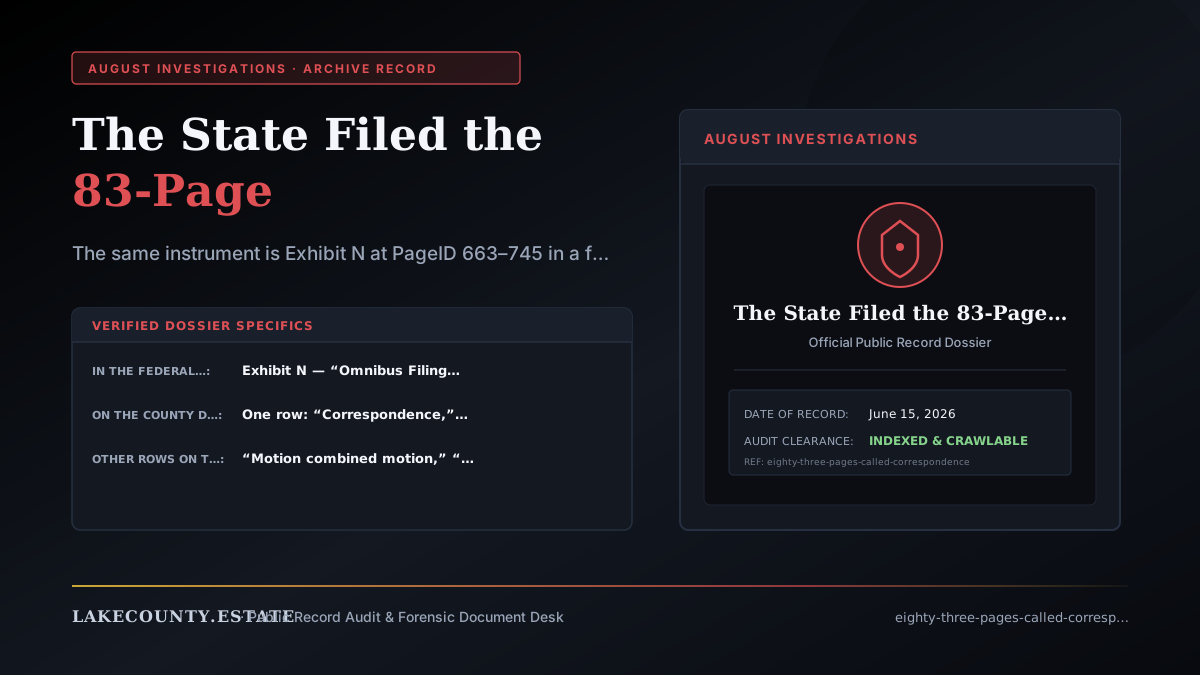
- The State filed that same instrument in federal court as Exhibit N, PageID 663–745.
- The county public case-action page identifies the June 15 entry as “Correspondence,” while other entries on the same page are separately identified by type.
What They Have Not Produced
- Who classified the entry, under what instruction, and on what date the row was created.
- The Odyssey audit trail: operator ID, terminal, received-date field, filed-date field, and before-and-after history.
- Whether any component motion in the filing has ever been set or adjudicated.
A document does not change when it moves between two computer systems. Its label does.
What the instrument is
Eighty-three pages, file-stamped by Lake County on June 15, 2026. Its first page identifies an emergency notice of motion, a special appearance, a remote-adjudication demand, a notice of constructive abandonment, a Faretta invocation, a request for standby counsel, a motion to quash the warrant, and a motion to dismiss the revocation. That is not correspondence by any definition a clerk’s office uses. It is a stack of motions.
How the State treated it in federal court
As Exhibit N. Eighty-three pages, PageID 663 through 745, described on the face of the brief as a “pleading captioned ‘Omnibus Filing,’ which, among other things, challenged the petition to revoke probation and the validity of the arrest warrant and requested to proceed pro se.” When the State needed to show a federal judge that this litigant was successfully filing things in Illinois courts, it filed the whole document and described it accurately.
How the county docket treats it
One row. One word. “Correspondence,” dated June 15, 2026 — on a public case-action page where the entries around it are separately identified as “Motion combined motion,” “Petition to Revoke,” notices, warrants, orders and minute records. The system plainly distinguishes document types. This one did not get distinguished.
What follows from a label
A motion gets set. Correspondence does not. No notice setting the component motions for hearing was received, and no written adjudication of them has issued. The warrant challenge inside that filing has never been ruled on. The Faretta invocation inside it was answered two days later by an order discharging counsel nunc pro tunc to October 6, 2025 — which acknowledged the substance while the docket row still says correspondence.
The record that resolves it, named precisely
Not another screenshot. The system-of-record audit data: authenticated operator ID, workstation or terminal identifier, original submission identifier, acceptance or override event, image creation time, image-to-docket attachment time, the received-date value, the filed-date value, the reason code, and the before-and-after history for that row. Every one of those fields exists inside a government system right now. Preservation of all of them was demanded on the federal record. None has been produced.
And the discrepancy this archive flags against itself
The source folder for this filing carries an unresolved page-count discrepancy — 82 pages as described in one place, 83 as stamped — and an unresolved question about which document the June 15 “Correspondence” row actually attaches to. Both are published rather than smoothed over. An archive that hides its own loose ends is asking to be believed instead of checked.