What the Record Establishes
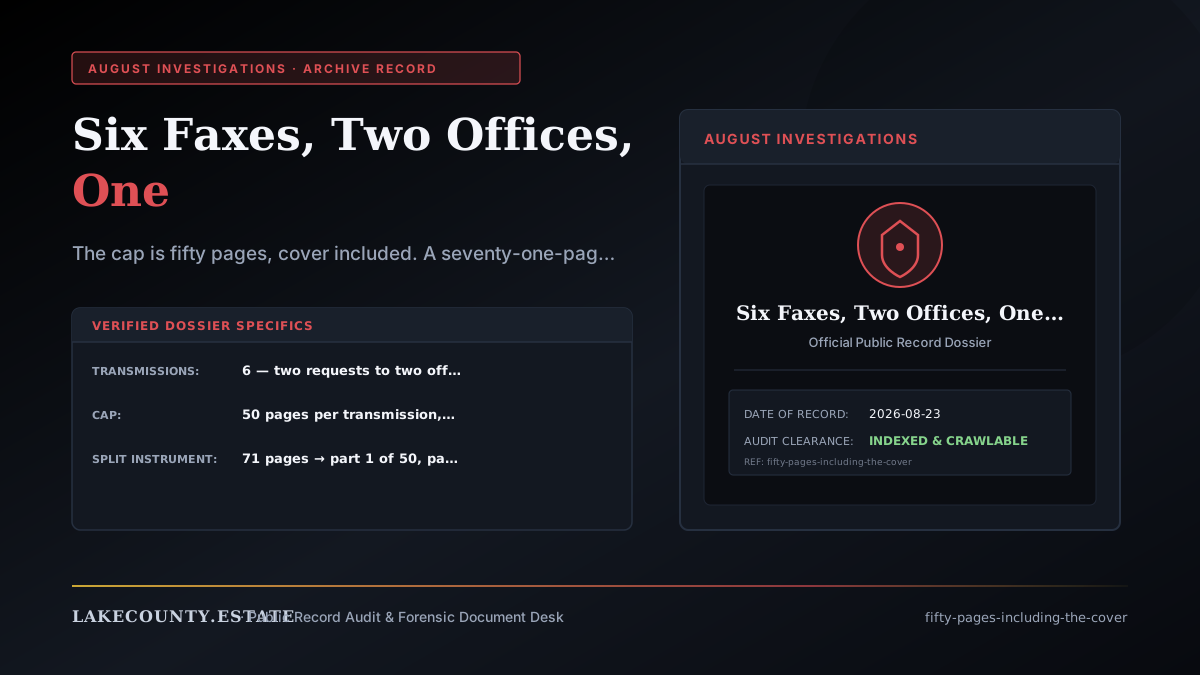
- Both requests were addressed to both Commission offices, producing six transmissions in total.
- Each cover sheet prints the SHA-256 digest of the complete original instrument, identical across the parts of a split document.
- Each cover states which pages of the original it carries and its own page total including the cover.
What They Have Not Produced
- Whether the Commission opens an intake file, which is confidential under Illinois Supreme Court Rule 766 and may never be public.
- Nothing else — this page is about transmission integrity, not outcome.
This page is not about what the requests allege. It is about how paper survives contact with an intake queue.
The cap is the design constraint
Fifty pages per transmission, cover sheet included. A seventy-one-page instrument therefore becomes two calls: fifty pages, then twenty-three. That is a mechanical fact, and the entire cover-sheet design exists to keep it from becoming an evidentiary one.
What a normal cover sheet does not do
Every cover in the pair prints the SHA-256 digest of the complete original document — the same digest on both. So a reviewer holding only part 2 can determine, from part 2 alone, that a part 1 exists, exactly which pages of the original it carried, and that both belong to one instrument. Each cover also states its own page span (“pages 50–71 of 71”) and its own total including the cover. A half-received disciplinary request sitting overnight in an intake queue is the worst possible state for it to be in; this is the design that makes the missing half provable rather than deniable.
Both numbers on both covers
Each cover prints the fax numbers of both Commission offices. That is deliberate: whichever office is holding the pages can see that the other office has them too, so neither opens a duplicate intake believing it is the sole recipient.
The contradiction the covers close before anyone notices it
Both underlying requests are dated August 6 and both say, on their own first page, that they were delivered by electronic mail on August 6 with no paper copy sent. The fax round was assembled on August 13 and dialed on August 14. Left alone, an August 6 instrument arriving by fax a week later reads as a contradiction on the face of the packet — and an intake reviewer who notices a contradiction starts wondering what else changed. So each cover states plainly that this is a re-transmission of the same instrument, unaltered, not a second or amended request, and that no copy is going to the respondent this time either. The question is answered before anyone has to ask it.
Confirmation sheets are the whole of the proof
One per transmission, six in total, each stapled to the first page of the part it confirms. If anyone ever says a part did not arrive, that sheet is the entire record and it cannot be reconstructed after the fact. The instruction in the send plan is blunt about it, and it is the same discipline that produced this archive’s earlier ledger of forty-three confirmed transmissions with receipt images and per-file digests.
What is deliberately not claimed
That an intake file was opened. That anything was substantiated. Rule 766 keeps the Commission’s file confidential and Rule 775 privileges the communication; both facts are printed on the covers. This page documents that paper was prepared, split correctly, and sent — and nothing beyond it.
The complete August transmission ledger, graded by the proof that exists for each entry.