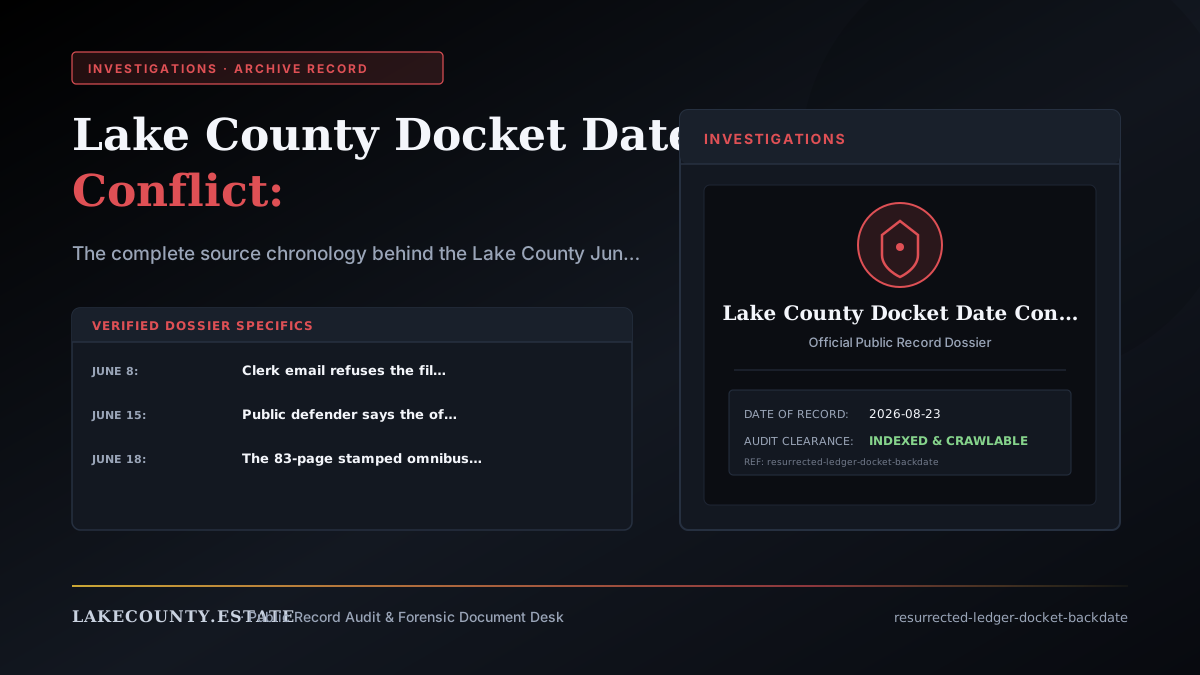
What the Record Establishes
- All four artifacts are preserved and hashed: the June 8 refusal, the June 15 stamp, the June 18 PDF creation time, the June 19 portal row.
- A document stamped June 15 carries embedded metadata reporting creation on June 18.
- An 83-page substantive omnibus was classified on the public portal as "Correspondence."
What They Have Not Produced
- The Odyssey audit log: every event, operator ID, workstation, and timestamp for this case.
- The received-date and filed-date field history for the June 15 row, before and after.
- Who created that row, and under what reason code.
The documentary conflict is direct: a substantive 83-page omnibus filing—containing a Faretta self-representation invocation, motion to quash warrant, remote-hearing demand, and federal evidence—was reduced on the public portal to “Correspondence” and assigned a June 15, 2026 date that conflicts with the preserved refusal, mail, and PDF chronology. The federal filing calls the event backdating; the authenticated event history can prove the actual intake, scan, field-entry, and attachment sequence.
What the clerk rejected on June 8
The June 8 clerk email did not accept or docket the submission. It said the case could not be added to the June 9 call because the office lacked the original motion and because “the motion must be filed by your attorney.” That email is preserved inside the federally filed docket-spoliation submission as Exhibit C.
What changed on June 15
At 7:24 p.m. on June 15, Assistant Public Defender Bailey Russell wrote that the office had not been reappointed after October 6, 2025 and that the clerk was incorrect to believe the public defender remained attorney of record. Later that evening, a written demand copied the Circuit Clerk and demanded correction of the filing lockout. This is the pressure point in the chronology: the stated reason for refusing the pro se papers had collapsed in writing.
The “mere correspondence” classification
The omnibus was not mere correspondence. Its first page identifies an emergency notice of motion, special appearance, remote-adjudication demand, notice of constructive abandonment, Faretta invocation, request for standby counsel, motion to quash warrant, and dismissal of revocation. Yet the June 19 public portal printout lists only “Correspondence” dated June 15. The generic label erased the substantive nature of the filing from the public-facing ledger.
The PDF metadata conflict
The native omnibus PDF is 83 pages and visibly carries a Lake County “FILED JUN 15 2026” stamp. But its embedded PDF metadata reports that the electronic file itself was created on June 18, 2026 at 3:15:57 p.m. EDT. A June 18-created electronic artifact bearing a June 15 filed stamp is not explained by the public portal. That gap is precisely why the credentialed audit log, image-ingestion history, received-date field, and operator trail matter.
The June 19 portal snapshot
The portal page printed June 19 at 1:31 p.m. displays four consecutive entries: June 18 Order; June 18 Minute Record; June 17 Order; and June 15 Correspondence. The page does not disclose when the June 15 row was actually created, who created it, which source document was attached, or whether its filed-date field was entered manually.
The federal exhibit chain
N.D. Illinois Case No. 1:26-cv-06738, Document 13, filed June 19, packages the contradiction into one stamped federal record. Exhibit A is the portal snapshot; Exhibits B and E are the undelivered USPS trail; Exhibit C is the June 8 clerk rejection; Exhibit D is the June 17 order carrying a June 18 file stamp; and Exhibit F is the June 17 preservation demand. The submission expressly identifies the event as a post-filing docket alteration and demands preservation of the backend audit trail.
Why the June 15 date creates a second problem
If the omnibus was received on June 15, then the Faretta invocation, remote-appearance demand, and warrant challenge preceded the June 17 proceeding. If the electronic package was not ingested until later, then the public June 15 value requires a documented received-date or administrative explanation. Either branch makes the native audit history indispensable.
The missing record that can resolve it
The decisive evidence is not another public-facing screenshot. It is the system-of-record audit data: authenticated operator ID, workstation or terminal identifier, original submission identifier, acceptance or override event, image creation time, image-to-docket attachment time, received-date value, filed-date value, reason code, and before-and-after history for the June 15 Correspondence row. Until that history is produced, the public ledger remains contradicted by its own source artifacts.