What the Record Establishes
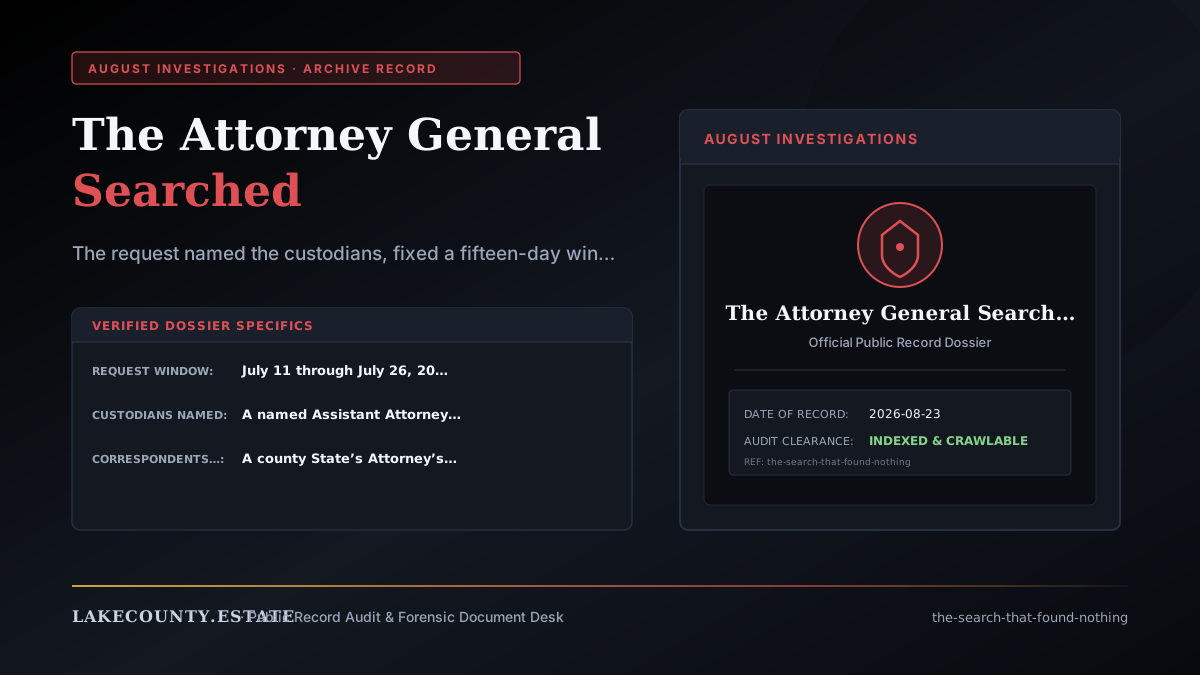
- The request was specific: named custodians, a fifteen-day window, an enumerated list of external correspondents, and an explicit exclusion list.
- The office answered that a search located no responsive records.
- A separate August 11 letter states that under section 3(c) the entirety of an electronic request must appear in the body of the submission.
What They Have Not Produced
- Which mailboxes, shared accounts, calendars and message-trace systems were actually searched, and under what search terms.
- Whether any custodian search certification exists for the 079127 search.
- Whether the same custodians hold responsive records outside the fifteen-day window.
A “no records” answer is not a nothing. It is an affirmative representation by a public body about the contents of its own systems, and it is only worth what the search behind it is worth. That is why the request published here is reproduced in full, over four pages, exactly as the office quoted it back.
The request was built so a search could not miss
It named a specific Assistant Attorney General and the personnel assisting her. It named supervisors and litigation-support personnel who received or transmitted responsive external communications. It named shared mailboxes, document-routing systems, calendars, collaboration accounts, and message-trace systems. It fixed a date range of July 11 to July 26 and said in bold that the range was deliberately non-overlapping with a separate pending request. It listed the external correspondents by office and by name. And it listed, in bold, five categories that were expressly not being asked for — including internal-only communications, public docket filings standing alone, and anything already produced under the earlier request.
The answer was one sentence
“Please be advised that this office has conducted a search of its records, and we have located no records responsive to your request.” The letter is published here in full. A notice of reliance went back the same day, so that the office would know in writing that the answer was being relied upon.
Then the second letter, which changed how everything is written now
On August 11 a separate response addressed a different submission and made a procedural point with real teeth: under section 3(c) of the Freedom of Information Act, the entirety of an electronic request must appear within the body of an electronic submission, and the office is not obligated to open electronically attached files or hyperlinks. That is the statute. It is also, in practice, an exit — a request sent as a PDF attachment can be closed without anyone reading it.
The correction was applied, not argued
On August 13 the operative request was restated in the body of the email, and the letter says on its face that it does so because the office said to. The same discipline was carried into the municipal FOIA sent the same day: its categories were pasted into the body of the message rather than attached, specifically so that no recipient could take the section 3(c) exit that the Attorney General had just described in writing.
Why this is the least dramatic and most useful page in the chapter
Nothing here alleges anyone hid anything. What it establishes is narrower and more durable: two agency positions are now fixed in writing, on dated letterhead, and every future request in this archive is drafted against them.