What the Record Establishes
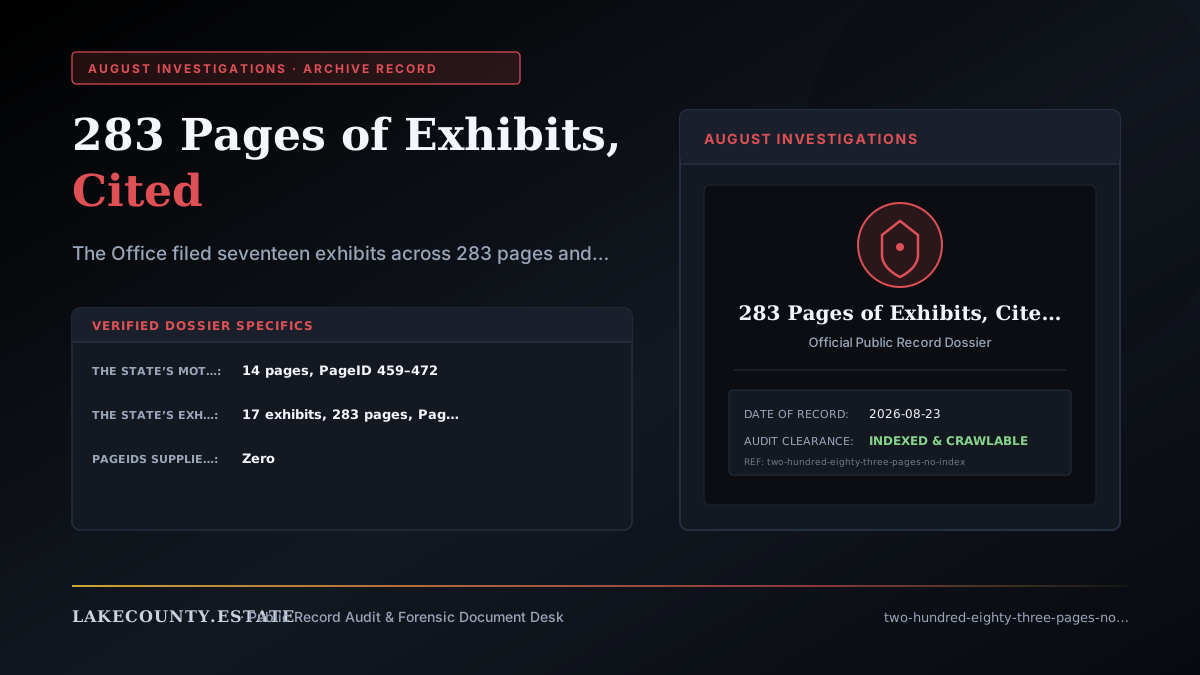
- The State cited seventeen exhibits by letter alone across a fourteen-page brief, supplying no PageID and no attachment number.
- Five of those exhibits were filed as images that return no text on extraction.
- The petitioner filed a concordance mapping every exhibit letter to its CM/ECF attachment and PageID span, and offered it to the court “whatever the disposition” of his own motion.
What They Have Not Produced
- Why five exhibits — including two that contradict the motion — were filed without a text layer.
- Whether the Office intends to supply an index of its own.
- What the three documents identified in the Rule 3.3 notice, and not disclosed in the motion, contain.
This is the least dramatic page in the chapter and it may be the most damaging, because it is entirely about craft.
What a citation is for
A record citation exists so a judge can check the claim without hunting. In federal practice the PageID is the address. Dkt. 51 runs fourteen pages, cites seventeen exhibits, and gives the court a letter for each one — A, B, C — across a 283-page attachment set filed in seventeen separate PDFs. To verify a single proposition, a reader must open attachments until the right one appears.
What the petitioner did about it
He built the table. Exhibit 1 to Dkt. 53 maps every exhibit letter to its CM/ECF attachment number, its PageID span, its page count, and the document as docketed. It runs the full sequence from PageID 473 to 755 and audits it: continuous, no gap, no overlap, no duplicated number. Then it was handed to the court with a sentence that gives away nothing — the table “is offered for the Court’s convenience in reviewing Dkt. 51, whatever the disposition of the motion it accompanies.” If his own motion is denied, the index stands.
The five that cannot be searched
Exhibits A, M, O, P and Q — the indictment, the warrant, the order discharging counsel, the order lifting the stay, and the certified case summary — were filed as images. Fourteen pages of the record return nothing to a text search. Two of them, O and Q, are the documents that answer the motion: the discharge order that makes counsel’s withdrawal retroactive to October 6, 2025, and the certified summary whose March 10 row reads “Status” and “Case Called.”
The notice that came first
Ten days before Dkt. 51 was signed, a notice under Illinois Rule of Professional Conduct 3.3 and Federal Rule of Civil Procedure 11(b) was served on counsel and filed on the docket. It asked five things: that two characterizations be omitted, and that three documents be disclosed. According to Dkt. 53, the motion kept both silences and made none of the three disclosures. Rule 11(b) asks an objective question about the inquiry a signatory made before filing. This archive does not answer that question. It records that it was asked, in writing, ten days early.
The line that should be read twice
From the motion for leave: “Petitioner would rather be checked than believed.” Everything on this site is built on that sentence. It is also, precisely, the standard the State’s filing did not meet on its own exhibits.
Read Dkt. 53 — the motion, the concordance, and the proposed reply.