Professional background
The court’s official biography records the following education and judicial-service background. Assignment and reappointment listings can lag later court announcements; these facts do not establish today’s docket assignment.
- Undergraduate: Valparaiso University, 1986
- Law School: Valparaiso University School of Law, 1991
- Judicial appointment recorded by the court: January 26, 2016
Official sources: Official biography or office record.
Source check: October 4, 2026. Career facts and public feedback are separate from the allegations and evidence discussed in the dated record.
Rate or discuss this profile — share a firsthand experience, disagreement or sourced correction.
What the Record Establishes
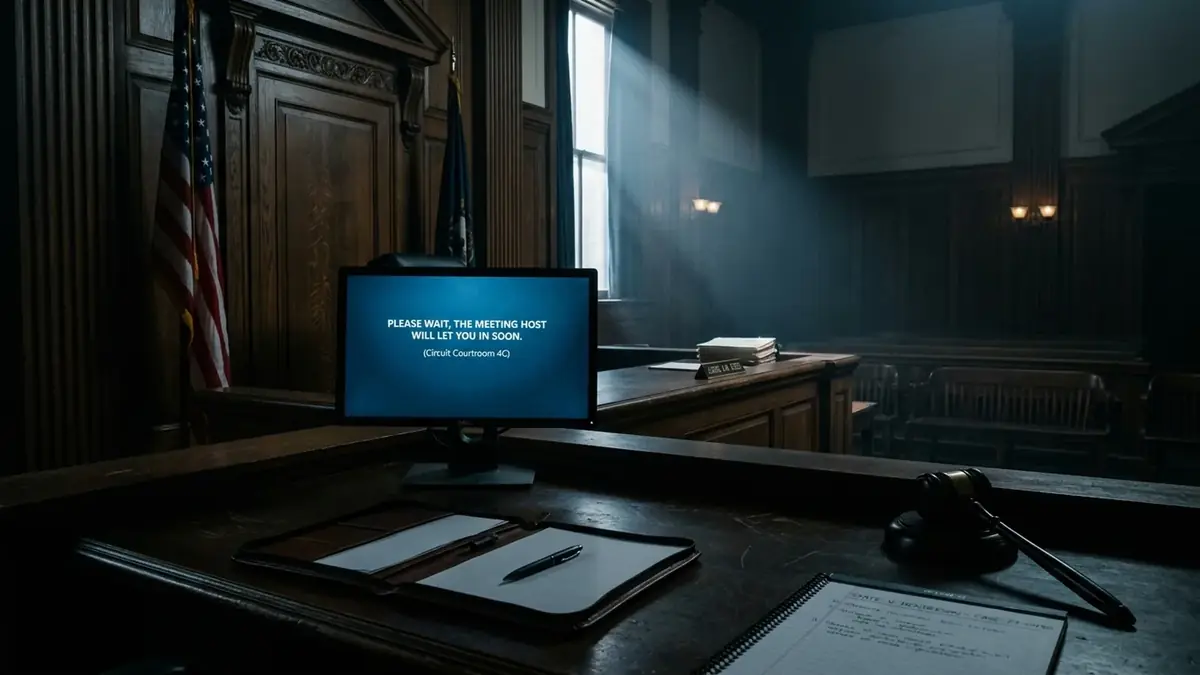
- The record: a custody order signed while the defendant was locked in the courtroom’s own Zoom waiting room.
- Documented act: Signed a stay-lift order on a 180-day custodial term during the June 17 proceeding.
- Contemporaneous record: Fourteen screenshots place the defendant in the Zoom waiting room, 9:18–11:00 a.m..
What They Have Not Produced
- Host-side Zoom telemetry for Courtroom T-611, June 17, 2026, 9:00-11:00 a.m.
- Every host admit and remove action with the acting account identified.
- The Odyssey audit-log entry showing when the June 17 order was created and published.
- Whether the pending for-cause substitution motion was referred to another judge.
The Power This Office Actually Holds
A presiding circuit judge controls the courtroom: who is admitted, when a matter is called, what is heard, and what orders issue. In a remote proceeding the court is also the technical host of the session, which means it controls admission to the hearing itself and holds the telemetry recording every admission decision.
- Presides over proceedings and signs orders affecting liberty
- Controls admission and participation in remote sessions as the hosting court
- Decides motions, including whether a matter proceeds in a party's absence
- Holds the session telemetry recording every admit and remove action
The record establishes what happened on June 17, 2026. Judge Christopher R. Stride presided over a proceeding that lifted the stay on a 180-day custodial term. At the same time, fourteen time-stamped screenshots place the defendant in the Nineteenth Judicial Circuit’s own Zoom waiting room — connected at 9:18 a.m., still waiting when the case was called at 9:43, ejected at 11:00 without ever being admitted. A defendant who is present at the court’s virtual threshold, visibly waiting, is not absent. The proceeding went forward anyway.
The conduct the filings charge
Proceeding on a custodial matter while the defendant is held outside the room is the conduct the federal filings place under 18 U.S.C. § 242 — deprivation of rights under color of law. The right at issue is not obscure: it is the Fourteenth Amendment right to be present and heard before liberty is taken. The Zoom lockout record lays out the minute-by-minute sequence the host-side telemetry can confirm.
The order that stayed off the books
The signed order did not become visible on the public eCourt portal until the following morning at 10:48 a.m. For roughly 26 hours a custody order existed that its target could not see, could not appeal, and could not stay. The mechanics of that interval — and why an order that cannot be seen cannot be challenged — are documented in Anatomy of a Pocket Warrant. The same file carries a June 17 order stamped June 18: one more one-day slip, in the same direction, in the same week.
What resolves it
One export ends the dispute: the host-side Zoom telemetry for Courtroom T-611, June 17, 9:00–11:00 a.m. — join events, waiting-room states, every admit and remove action. The court is the account holder. That record has been demanded and, as tracked on the Silence Ledger, not produced.
Still Not Produced
Each of these records exists inside a government system. Each has been requested. None has been supplied.
- Host-side Zoom telemetry for Courtroom T-611, June 17, 2026, 9:00-11:00 a.m.
- Every host admit and remove action with the acting account identified.
- The Odyssey audit-log entry showing when the June 17 order was created and published.
- Whether the pending for-cause substitution motion was referred to another judge.
If any of it is produced, or if Christopher R. Stride disputes a documented fact on this page, the response will be published here in full, with its date. Read the correction standard.
Follow the same record into the next office
See every named official → · Rate this profile or add context →