What the Record Establishes
- A twenty-two-minute escalation sequence on July 17 placed four separate notices in front of the same attorney, at four recorded times.
- A Village Manager acknowledged in writing on July 20 that a litigation hold had been in force since June 6, 2026.
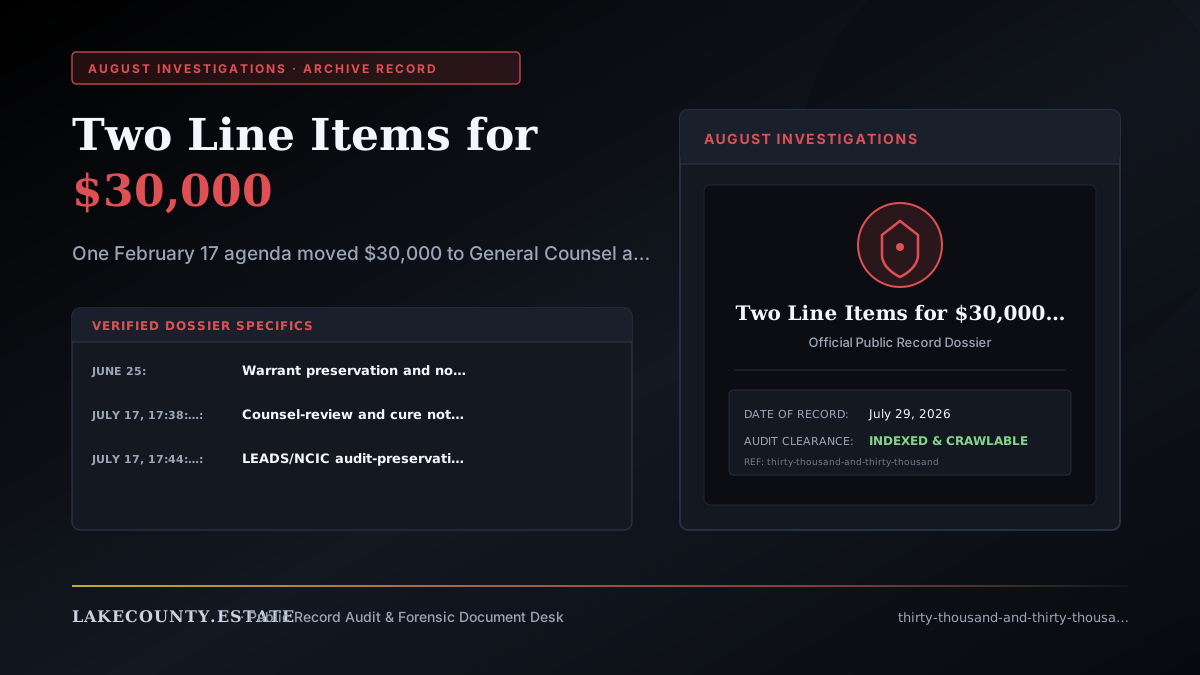
- A February 17 municipal agenda shows a $30,000 transfer to General Counsel and a $30,000 increase for outside counsel.
What They Have Not Produced
- A verified conflict disclosure from outside counsel.
- Whether any attorney at that firm ever asked the Village to cancel the warrant entry under its ORI.
- The matter-coded billing records that would show what the two $30,000 line items were for.
The filing prints four dated facts about the same attorney and then says, in terms, that it draws no conclusion from them. That is not timidity. It is the most difficult form of a document to answer, because there is nothing in it for opposing counsel to deny.
The notice trail is minute-stamped
On June 25 a corrected preservation and warrant-nonexecution notice went simultaneously to the Village Attorney, the firm’s general inbox, police command, Village administration, the county Sheriff, the State’s Attorney, and court actors — with a Gmail message ID recorded on the face of the filing. On July 17, in a twenty-two-minute sequence, the same attorney was a direct addressee of a counsel-review and cure notice at 17:38:41, a command-and-counsel LEADS/NCIC audit-preservation demand at 17:44:09, and a board-level independent-review and risk-tender notice at 17:51:09; at 18:00:46 he was copied on the Public Access Counselor request for review.
The institution answered three days later
On July 20 the Village Manager wrote that the Village was in receipt of the July 17 electronic communications, acknowledged a litigation hold “in force since June 6, 2026,” and confirmed that related records would be retained. That is an institutional acknowledgment of notice and of preservation, in writing, on a date.
The two line items
The February 17 agenda of a different municipality — the defendant in the chancery case — shows an exact-dollar pair: $30,000 moved to General Counsel and a $30,000 increase in the authorization for the same outside firm, on an agenda that also contemplated closed-session litigation. The supplement reproduces the agenda. It does not say what the money was for. It asks for the matter-coded billing records that would say.
The warrant-agency discrepancy sits underneath all of it
The Sheriff’s Warrant Details record identifies ORI IL0492900 — a municipal police department — as the issuing agency for the warrant. That municipality has disclaimed involvement. The same firm’s partner serves as that municipality’s Village Attorney while the firm appears adversely in the chancery case. The filing states those four facts and stops. The August 13 letter then asks the quiet question that follows from them: has anyone, including any attorney at that firm, ever asked the Village to cancel this entry? One word answers it. If the answer is no, the disqualification motion has its best exhibit, written by the responder.
Why this page names a firm and not a person’s motive
Because the record supports the first and not the second. Appearances, dated notices, an acknowledgment, and a published agenda are documents. Intent is not in any of them, and this archive does not manufacture what the paper does not contain.