Professional background
The Illinois Attorney General’s Office conducts litigation on behalf of the state and the public interest. A fuller official career biography for this individual was not located in the sources checked. The role documented below belongs to the dated record; current employment, education and prior posts are not inferred from it.
Official sources: Official biography or office record.
Source check: October 4, 2026. Career facts and public feedback are separate from the allegations and evidence discussed in the dated record.
Rate or discuss this profile — share a firsthand experience, disagreement or sourced correction.
What the Record Establishes
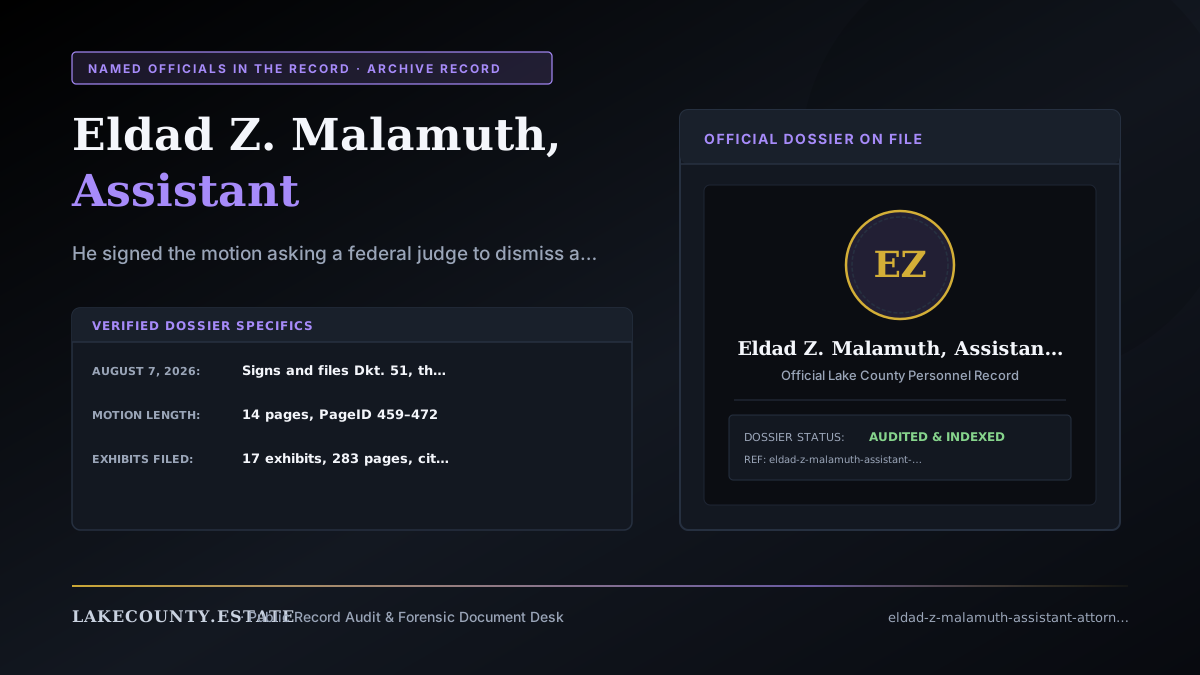
- He signed the motion asking a federal judge to dismiss a habeas petition because Illinois’ corrective process was available — filed the same day an Illinois appellate clerk refused the petitioner’s state filing.
What They Have Not Produced
- Whether the Office was aware, on August 7, that an Illinois appellate clerk had refused this litigant’s filing that day.
- What the three documents identified in the Rule 3.3 notice contain, and why none was disclosed.
- Why five exhibits — including two that answer the motion — were filed without a text layer.
The Power This Office Actually Holds
An Assistant Attorney General represents the State and its officials in federal habeas proceedings. The attorney who signs a federal filing certifies under Rule 11(b) that its factual contentions have evidentiary support, formed after an inquiry reasonable under the circumstances. Counsel chooses which exhibits to file, how to cite them, and in what form.
- Represents the respondent in federal habeas corpus proceedings
- Selects, files and characterizes the state-court record placed before the federal court
- Certifies factual contentions under Fed. R. Civ. P. 11(b) by signing
- Speaks for the Office of the Attorney General on the adequacy of Illinois corrective process
This page is about a signature and the paper under it. It alleges no misconduct, and it does not need to.
The position taken
Dkt. 51 argues that the petitioner’s account of being locked out of Illinois courts describes “merely the procedures every pro se criminal defendant must comply with.” That is the State of Illinois telling a federal judge that its own corrective process was adequate. It is the position that puts every state-court refusal in this archive directly in issue.
The four representations answered by the State’s own exhibits
On the petitioner’s count, Dkt. 51 makes eighteen discrete factual representations, and on four of them the cited document says the opposite of the sentence citing it. Two are dispositive: the “dismissal for want of prosecution” label, which the certified transcript at PageID 657 does not contain; and the April 28, 2026 certiorari expiration date, from which every deadline in the motion is computed.
The form of the filing
Seventeen exhibits, 283 pages, no index, no PageID, no attachment number, and five exhibits filed as images that cannot be word-searched. The petitioner built and filed the concordance himself, and offered it to the court regardless of whether his own motion was granted.
The candor that is also on the record
Asked on August 8 whether the State objected to an over-length reply, he answered in writing that the Office had no objection to thirty pages. That answer is quoted verbatim in the petitioner’s own motion, and the petitioner disclosed to the court that the nine pages beyond counsel’s number are presented as opposed. Both sides’ conduct on that exchange is in the record, and this archive publishes both.
The standing offer
If any factual statement on this page is disputed in writing, the response is published here in full, with its date, at equal prominence.
The Documented Chronology
- July 8, 2026
The district court orders a response by August 10 and permits a reply by August 31.
- Late July 2026
A notice under Ill. R. Prof. Conduct 3.3 and Fed. R. Civ. P. 11(b) is served on counsel and filed of record, asking that two characterizations be omitted and three documents disclosed.
- August 7, 2026
Dkt. 51 is signed and filed. Per Dkt. 53, it kept both silences and made none of the three disclosures.
- August 7, 2026
Dkt. 52 notices presentment for August 19 at a courthouse the motion’s own Exhibit M makes unsafe for the petitioner to enter.
- August 8, 2026
He states the Office’s position on an over-length reply in writing.
- August 10, 2026
Dkt. 53 and Dkt. 54 answer the motion out of the exhibits the motion filed.
Still Not Produced
Each of these records exists inside a government system. Each has been requested. None has been supplied.
- Whether the Office was aware, on August 7, that an Illinois appellate clerk had refused this litigant’s filing that day.
- What the three documents identified in the Rule 3.3 notice contain, and why none was disclosed.
- Why five exhibits — including two that answer the motion — were filed without a text layer.
If any of it is produced, or if Eldad Z. Malamuth disputes a documented fact on this page, the response will be published here in full, with its date. Read the correction standard.
Follow the same record into the next office
Every named official → · The investigation behind this dossier → · Add context or rate this profile →